
Inside the World of LOVEGHOST’s Thirteen
“I wanted to create an entire universe that I was trying to welcome the listener into.”
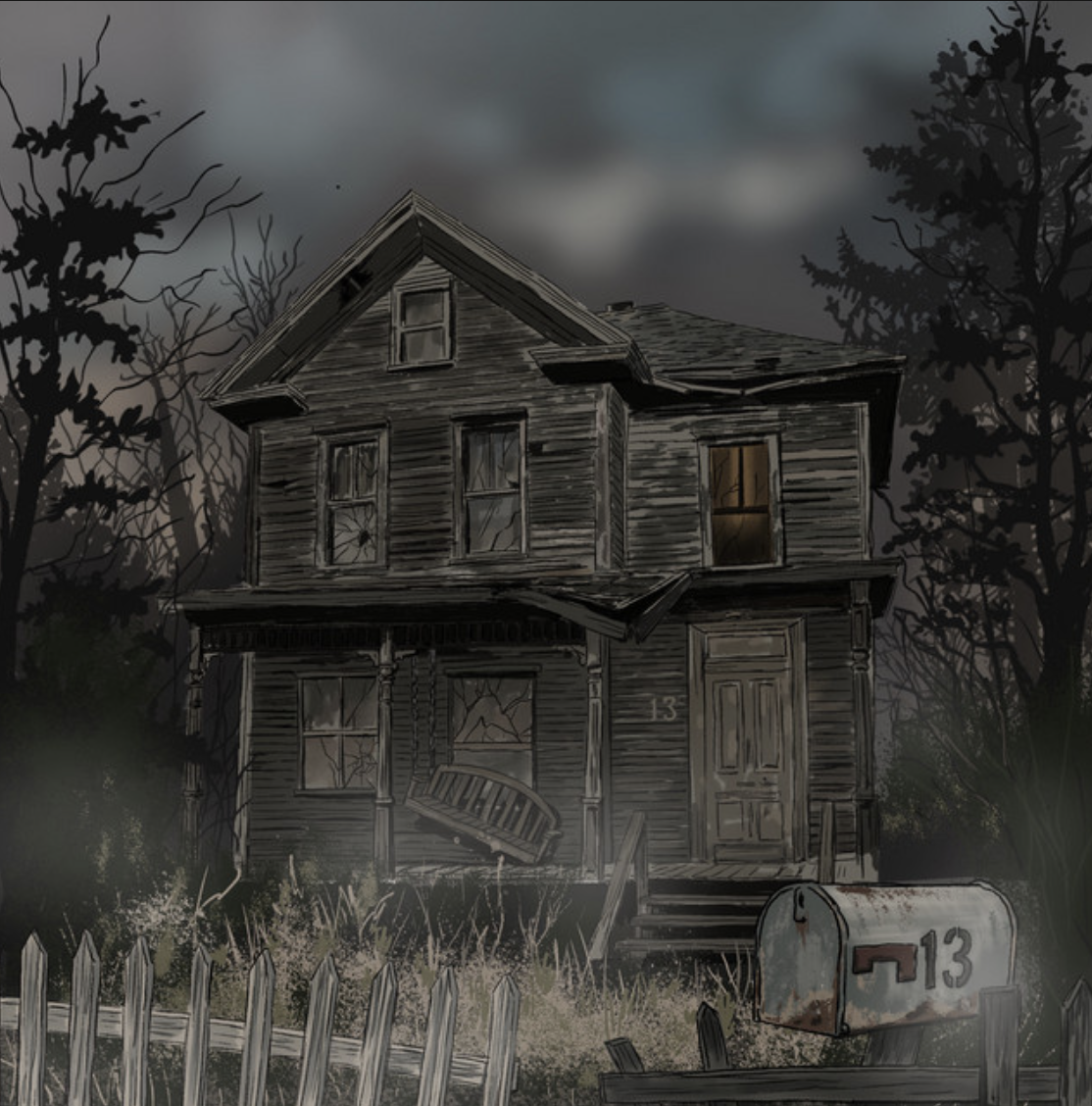
For Love Ghost’s Finnegan Bell, that universe existed before the music. Before writing a single song for thirteen, he already knew what he wanted the album to look and feel like. “I had a Pinterest board of just images of dilapidated houses in the Midwest and downtrodden neighborhoods,” he explains. “I printed it out and had it nailed to the wall while writing all the songs to kick-start the inspiration for it.”
Inspired by the isolation in Gummo, Bell imagined “the kids that are growing up in the middle of Nebraska and Idaho that have nothing to do with their days. What are they feeling? What are they experiencing?” He wanted the album to capture that feeling of growing up somewhere isolated, where the surroundings become part of the story. The images weren't just inspiration for the artwork. They helped establish the atmosphere he wanted every song to live in.
“I would say it's just a mix, kind of 50/50,” Bell explains when asked how much of the record comes from his own life versus imagined experiences. “Sometimes I'd be writing from third person, but some of the songs on the album are also very deeply personal.” He describes trying to reach a subconscious flow state when writing, comparing the process to Salvador Dalí's approach to painting. “I try to flow into that sort of dream state of the lyrics and of the music. That's where I'm most creative.”
That authenticity comes through in songs like “Turpentine This House,” which touches on the Eaton Fire, where Bell grew up, and “Something in the Water,” a song about generational trauma. “I just almost imagined this lake and this town where everyone was swimming in or metaphorically baptized in,” he says. “It was my way of just talking about generational trauma that people go through, or that I had gone through personally.”
The record came together over the course of the summer, from June through August. Bell engineered his own vocals and acoustic guitar, building ideas on his computer before sending them to producer Mike Summers in Kansas City. The two had worked together for years, including on “Angelelic,” an acoustic song about unrequited love that consistently became a moment during their live shows. Bell remembers people taking out their phones and turning on their flashlights when they played it live, and seeing that response sparked an idea.
“We said, what if we created an entire album that sort of fit into this universe of this somber, acoustic, emotionally intense lyrics world?” That became the foundation for thirteen.
Bell worked out of a studio space in a Glendale warehouse near the LA River, a place that also serves as the band's rehearsal space. Having somewhere separate from home to create has become an important part of his process. “There's something about having a creative space that you can go to, and it's just purely for creation,” he says. “Psychologically, it just creates a kind of oasis for me.”
“Into the Woods” was the first song written for thirteen, making it the natural choice to introduce the record. Bell released it alongside “Something in the Water,” partly because he had never put out two singles at once and wanted to see how listeners would respond. “I always got excited when artists would release two songs as a single at once. I thought that was super cool,” he says. “Honestly, I just wanted to try it out.”
The reactions have been different. “I'm getting deeper responses to ‘Something in the Water.’ I notice the comments are a lot longer,” he says. “‘Into the Woods’ is more just eye-catching, and people are first grabbing on.” But it's those deeper responses that stay with him, especially when listeners share their own experiences with the heavier subjects in his music.
“The deep comments and the resonation with songs as heavy as this is almost, in a way, the reason why I keep on making music.”
Bell remembers being “a bit of a troubled youth,” getting kicked out of school and eventually attending continuation school. “I didn't really have a lot of people to talk to about those things, but I would just listen to a lot of music all the time. Music was my saving grace.” He says he always hoped to write songs that could reach someone else going through something similar. “I felt like, okay, one day, I want to have the experience of writing these songs, of writing songs that connect with the next person that's going through something like that.”
It's a connection he now gets to experience firsthand. The album's first release party brought a reaction he wasn't entirely expecting after spending so much of its creation working alone. “It was truly just me sitting on a computer, my parts, sending it to my producer, Mike Summers. He would work on it alone. I'd send it to the other band members, and they would work alone in their space.” Hearing people sing those songs back to him, then getting to speak with them about what the lyrics meant to them, made the experience feel entirely different. “It's still that universal language of suffering, or whatever, however you may call it. It's a really special experience.”
That audience connection has taken Love Ghost somewhere Bell never expected. Mexico was the first place to show the project significant support through YouTube and social media. He eventually moved there for a period, living in an abandoned elementary school with other music artists and musicians while recording every day. Now, much of the band's live activity takes place in Mexico, and the current lineup includes two members from the country, alongside musicians from California.
“It was completely unexpected,” Bell says. “I was almost overlooked in the place that I was from, in LA, and then all of a sudden I just had all these supporters in another country that I had never been to before.” He began teaching himself Spanish, met musicians who would eventually join the band, and found a community that became a major part of Love Ghost.
Love Ghost has gone through several different lineups since Bell first started the project at twelve. Back then, it was just him and an acoustic guitar, playing coffee shops and backyards wherever he could. That same guitar made its way onto thirteen. When asked whether returning to an acoustic record was intentional, Bell admits it was probably subconscious.
“I set out to write this album on the acoustic guitar that I’ve had when I was 12, playing in random backyards and coffee shops,” he says. “When I first decided that I wanted to have a music project, and now here we are a decade later.”
The visual side of thirteen is still expanding, with five music videos planned for six songs. Bell originally wanted to make an entire short film to accompany the album, but the project became too expensive to pull off. Instead, he's building a loose storyline that connects the videos, leaning into a homemade, VHS-inspired aesthetic with a little of the Blair Witch Project in its approach.
The videos are made alongside a group of directors and cinematographers who understand the direction he's after. King Zab directed “Turpentine This House,” Pablo directed “Blood and Roses” in Mexico City, and Keith Coleman handled the cinematography for “Into the Woods.” Bell writes ideas and sends references to each collaborator, laying out how he wants the videos to feel.
“I'll write up these treatments, and I'll send them to them, like, ‘Hey, I want the videos to look like this, to feel like this. Here's kind of a mini script of what I want to happen in the video.’” He still hopes to make the original short film one day, but for now, the music videos are giving the album's world room to grow. “I always love making visuals for the project. That's always a fun day when I get to do that, and it's always an even better day when you get to watch it back after and be like, yes, my vision came to life.”
Review by Bek Allegretti