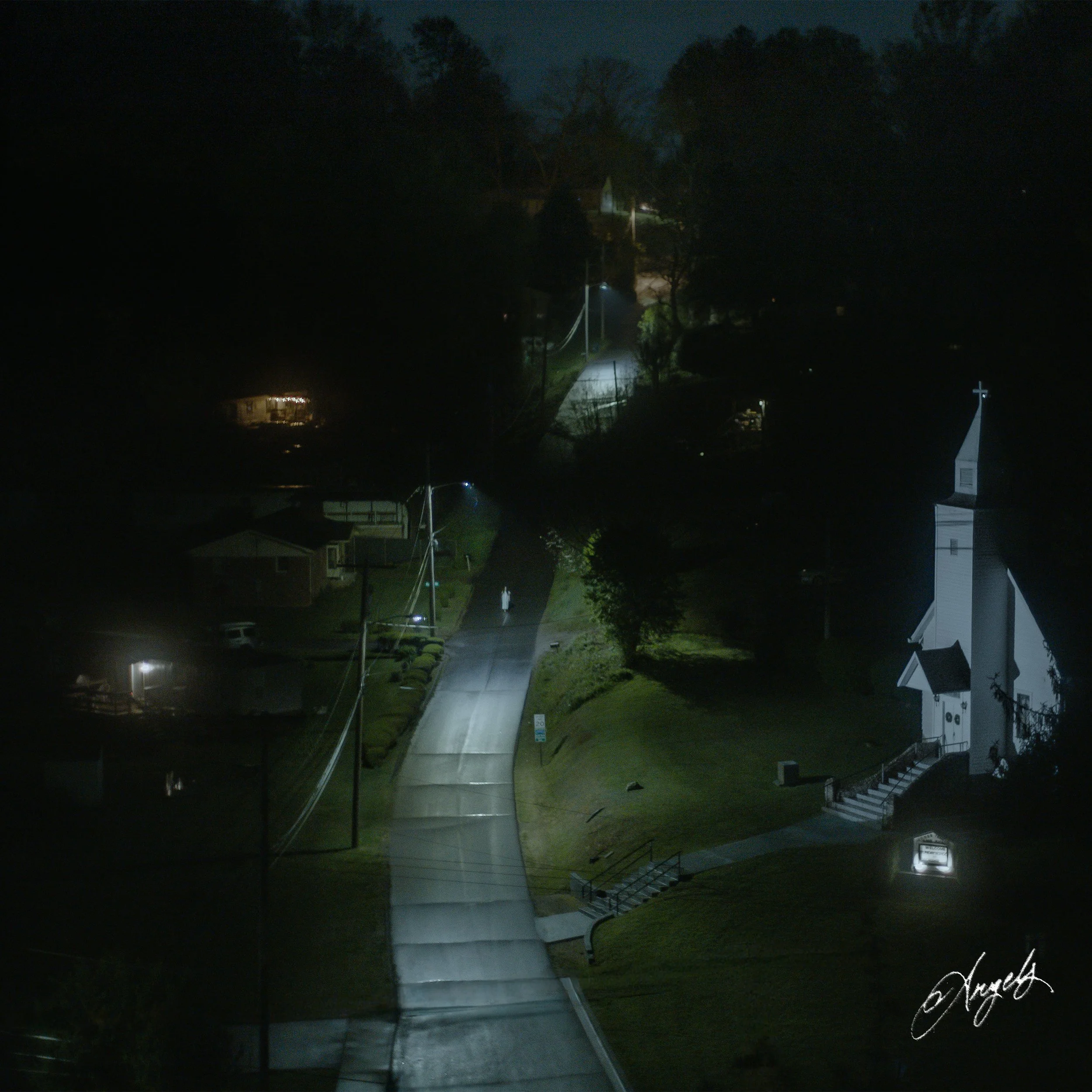
Scarlet House has never been interested in spelling everything out. He leaves his music open, allowing the feelings and interpretations to speak for themselves. Angels, the new 14-track release that traces one relationship from its first moments through its eventual unraveling, begins from the honeymoon phase with songs like “WITH YOU” and “FLY”, before transitioning into the downward spiral of the relationship with “CHEMTRAILS” and “ASHVILLE”, bookended with two instrumentals titled “START” and “END” to complete the record.
Kameron Odums is the Charlotte based artist behind Scarlet House, a project that has become his emotional outlet for his blend alternative, R&B, and electronic music. At 25, Odums handles much of the music himself, from writing and production to mixing, giving Scarlet House a sound that feels distinctly his own.
The story is personal, but the details stay deliberately out of reach. Finding that balance between telling the story and keeping parts of it to himself became one of the more difficult parts of making the record.
“I think trying to tell something so close to home and dear to me while also not putting too many details out in the world and also not saying too much about the situation,” Odums notes. “I think that was a challenge in its own thing.”
The idea for the album’s structure came partly from Frank Ocean’s nostalgia, ULTRA, specifically the way the record creates a sense of coming full circle. Scarlet House wanted to approach Angels similarly, opening and closing the record so the relationship feels like one complete story.
“I was having the goal of telling a story of a relationship, pretty much start to end, all the turmoil that kind of goes on as it goes downhill and ends up at the end,” he explains.
Frank Ocean has been part of Scarlet House’s musical world long before Angels. Odums credits Ocean with being the reason he started singing in the first place, but it is the way Ocean approaches storytelling that has stuck with him most.
“Obviously, it doesn't sound anything like Frank Ocean,” Odums points out. “But I think mostly what I take from him is his lyricism and he's really good at telling his story without telling you the story.”
That inspiration is highlighted throughout Angels. The listener gets the shape of what happened without being given every detail, which leaves the songs open to interpretation without taking away from the story that inspired them.
That same balance became important in the writing itself. Scarlet House has become comfortable producing and mixing his own music, but the independence is less about wanting to work alone and more about being able to get an idea out the way Odums hears it in his head. His interest in production started during a major R&B phase in high school, when he found out that artists like PARTYNEXTDOOR were making their own music. The idea that he could build an entire song himself stuck with him.
“I think sometimes it's easier to, when I know what I want to get out of it, just do it alone than try to talk to someone and communicate,” he admits. “Maybe that's a communication problem for me.” Odums laughs when he says it. Scarlet House describes himself as naturally reclusive at times, which works in his favor when he makes music. A song can start with a few hours alone in his room, getting the bones of it together before he returns to add and change things.
That process has shifted somewhat with Angels, as he began working with another producer who could take those initial ideas and build them out further. The core of the songs still starts with him, though, and so does the writing.
Writing about something personal also meant figuring out what belonged in the songs and what did not. That question follows Scarlet House beyond Angels, particularly when he talks about his faith. His relationship with faith has been complicated, especially when it comes to the difference between saying you believe something and actually living as you believe it. “I think I've been able to put that confusion and curiosity into some of the music,” he says.
It has also become part of the way Odums deals with creative frustration. When he cannot get an idea out, he describes stepping back, centering himself, and starting over. “It’s kind of therapy in my life in a way,” he reveals. That relationship with God is still something he is figuring out rather than something he presents as having all the answers to. “I'm not saying that I'm perfect and I have all the answers, but I think the way that I go about life now is kind of like I want to have God at the center of it,” Odums continues. “And I want to, like, have that be the main thing in my life.”
The idea of telling a story through different forms has interested Scarlet House for years, too. In high school, watching Enemy, the Jake Gyllenhaal film, pushed him toward the idea of writing stories himself. Odums thought he might write a movie. Instead, he wrote a song.
The movie idea never completely went away. Given the opportunity, Odums would like to work on music for film someday, pointing to artists who have moved between music and cinema as an example of what that could look like.
For now, that visual side of his creativity has found another outlet through Angels. Scarlet House is quick to admit that creating visuals is not necessarily his strength. “I know how to tell a good visual, but I'm not good at creating good visuals,” he admits.
Photographer Briscoe Park helped guide the creative direction for the album, while Scarlet House’s friend Chris works on tour content and some of the more spontaneous photos and videos. The cinematic quality of Angels was not something Scarlet House had mapped out from the beginning. Odums explains the idea of creating a world around the album did not really click until he was halfway through making it, after returning to his dad’s house following the tour and working through the songs with his friend and producer Brody McKeegan.
“We talked about the vision and the vibe that I was looking for, and we brainstormed and came up with this world together,” he shares. “ I was very influenced by a lot of movies at that time. I was watching a lot of love stories.”
One in particular stuck with him. “Eternal Sunshine of the Spotless Mind” had found him at the right point in his life, Odums shares, and its influence ended up making sense alongside the world he was building through Angels. “It's such a cliché love movie, but I watched it at the perfect time in life, and it hit me,” Odums says.
Those influences helped shape the world around Angels, but the album still belongs to the listener once it is out in the world. Scarlet House knows exactly where these songs came from, but he does not expect everyone who hears them to see the same thing in them.
“I just hope that people listen with open ears and open hearts.”
Interview by Bek Allegretti / Album Cover by Briscoe Park